Port of Abidjan Welcomes Its First Dedicated Car Carrier: A New Routinised Hub for West African Used-Vehicle Logistics
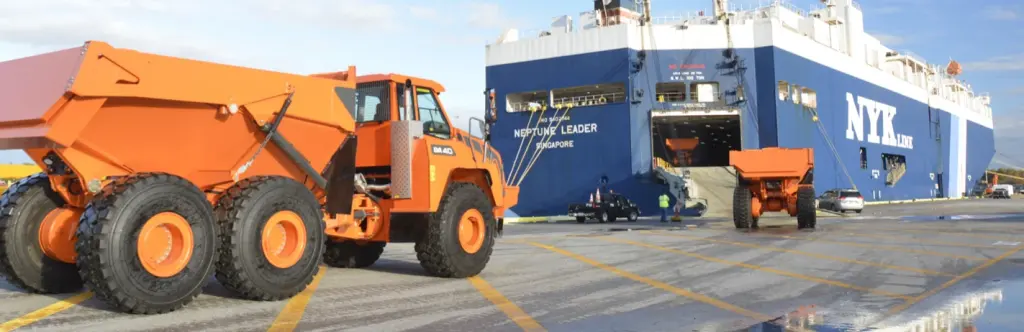
On October 24, 2026, the dedicated car carrier M/V NEPTUNE LEADER (183 metres long), operated by the Japanese shipping company NYK Line, called for the first time at Côte d’Ivoire’s Port Autonome d’Abidjan, completing the unloading of 139 whole vehicles in under 24 hours. AGL Côte d’Ivoire — a company with Chinese-funded investment and local registration and operation — served as NYK Line’s appointed ship agent in West Africa for this maiden voyage.
NYK has explicitly positioned the Port of Abidjan as a strategic pivot for expanding its West African automotive shipping network, aiming to serve the region’s growing demand for used-vehicle imports and new-energy vehicle distribution. Asta-Rosa Cissé, AGL’s Regional Director for West Africa, said that the efficient coordination of this operation benefited from its mature experience in RoRo operations, documentation compliance and multi-party coordination. This cooperation marks the point at which the Port of Abidjan formally possesses the capability to routinely receive and discharge dedicated car carriers, further strengthening Côte d’Ivoire’s status as a West African automotive logistics hub.
Why Should Used-Vehicle Export Enterprises Care About This?
For Chinese used-vehicle export enterprises that mainly source left-hand-drive vehicles, the West African left-hand-drive market is one of the main battlefields of their current African business. The logistics corridor of the West African market has long suffered from a structural contradiction: the primary destinations for Chinese vehicle sources are concentrated in countries along the Gulf of Guinea, such as Nigeria, Ghana, Benin and Togo, yet dedicated RoRo capacity has long been tight, with sparse sailings and hard-to-book slots being the norm.
Although the Port of Abidjan previously had RoRo berths, regular calls by dedicated car carriers were unstable. NYK Line’s maiden voyage here, with an explicit positioning of the port as a West African strategic pivot, means Côte d’Ivoire is shifting from an "optional transit point" to a "routinised RoRo destination port." For export enterprises that need to distribute vehicle sources to Côte d’Ivoire itself and the surrounding inland countries, this adds a predictable logistics option, without having to depend entirely on the slot availability and congestion of traditional hubs such as Lagos or Tema.
From a broader perspective, West African RoRo capacity is undergoing a round of expansion. Grimaldi Group has upgraded its China-to-West Africa service to a sailing every 15 days, departing from Ningbo and Taicang, transiting Durban to reach Lagos, with Lagos’s PTML terminal then connecting ports such as Abidjan, Tema, Douala and Dakar. The maiden call of a dedicated car carrier at the Port of Abidjan echoes this network expansion — the "channel density" of West African automotive logistics is rising.
Beyond Logistical Convenience, Côte d’Ivoire’s Compliance Threshold Has Not Loosened
It is worth noting that an improved logistics corridor does not equal a relaxation of market access. Côte d’Ivoire’s age limit for imported used passenger cars is among the strictest in West Africa: the age ceiling for passenger cars is 5 years, and for light commercial vehicles 7 years, with the age calculated from the vehicle’s first registration date in the country of origin rather than its manufacturing year. Over-age vehicles will be directly rejected by customs, and the importer must also bear administrative fines and the costs of return shipment or destruction.
In addition, the ECTN (Electronic Cargo Tracking Note) must be arranged before shipment, and the certificate number must be shown on the bill of lading. The facilitation of the logistics channel solves the question of "whether the vehicles can arrive at port smoothly"; while vehicle age and documentation compliance solve the question of "whether the vehicles can be cleared once they arrive at port." Both are indispensable.
The routinisation of RoRo calls at the Port of Abidjan adds a predictable logistics option for the West African left-hand-drive market, particularly suited to export enterprises whose source structure is dominated by near-new vehicles under 5 years old and who wish to enter the Côte d’Ivoire market directly or distribute to neighbouring francophone countries.
But for traders specialising in medium- and high-age vehicle sources, Côte d’Ivoire’s five-year red line has not changed because of the logistics improvement. Product selection logic must still start from the regulations of the destination country, rather than from logistical convenience. During the window in which the logistics corridor is expanding, moving compliance forward into the product selection stage holds more long-term value than simply chasing new shipping routes.